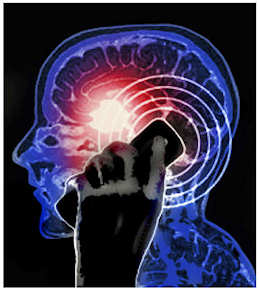
Gsm-gebruik verhoogt risico op hersentumor met 290%
- Gegevens
- Gepubliceerd: maandag 17 september 2012 07:25


More and more evidence from over 50 years of researches on the effects of electromagnetic radiation on male reproduction show that a certain dose of electromagnetic radiation obviously damages male reproduction, particularly the structure and function of spermatogenic cells. The mechanisms of the injury may be associated with energy dysmetabolism, lipid peroxidation, abnormal expressions of apoptosis-related genes and proteins, and DNA damage.
Cell Biochem Biophys. 2012 Aug 29. [Epub ahead of print]
There are possible hazardous health effects of exposure to radiofrequency electromagnetic radiations emitted from mobile phone on the human reproductive pattern. It is more effective while keeping mobile phones in pocket or near testicular organs. Present review examines the possible concern on radio frequency radiation interaction and biological effects such as enzyme induction, and toxicological effects, including genotoxicity and carcinogenicity, testicular cancer, and reproductive outcomes. Testicular infertility or testicular cancer due to mobile phone or microwave radiations suggests an increased level of reactive oxygen species (ROS). Though generation of ROS in testis has been responsible for possible toxic effects on physiology of reproduction, the reviews of last few decades have well established that these radiations are very harmful and cause mutagenic changes in reproductive pattern and leads to infertility. The debate will be focused on bio-interaction mechanism between mobile phone and testicular cancer due to ROS formation. This causes the biological damage and leads to several changes like decreased sperm count, enzymatic and hormonal changes, DNA damage, and apoptosis formation. In the present review, physics of mobile phone including future research on various aspects has been discussed.
Abstract
Increasing use of mobile phones creates growing concern regarding harmful effects of radiofrequency non-ionizing electromagnetic radiation (NIER) on human tissues located close to the ear where phones are commonly held for long periods of time. We studied 20 subjects in the 'mobile phone group' who had a mean duration of mobile phone use of 12.5 years (range 8-15) and a mean time use of 29.6 hours per month (range 8-100). Deaf individuals served as controls. We compared salivary outcomes (secretion, oxidative damage indices, flow rate and composition) between mobile phone users and non-users. We report significant increase in all salivary oxidative stress indices studied in mobile phone users. Salivary flow, total protein, albumin and amylase activity were decreased in mobile phone users. These observations lead to the hypothesis that the use of mobile phones may cause oxidative stress and modify salivary function.
ABC Science / stopumts.nl - Een nieuwe Australische studie toont aan dat sommige personen veel grotere effecten ondervinden door blootstelling aan gsm-straling dan anderen. De studie focuste met name op het effect op de hersengolven. Een vervolgstudie wees uit dat bij de mensen bij wie een groter effect op de hersengolven werd vastgesteld, ook de hersenactiviteit tijdens de slaap meer beïnvloed werd.
Professor Rodney Croft wijst erop dat sommige mensen bijna niet reageren, terwijl andere mensen heel sterk reageren. Hieraan liggen allicht fysiologische verschillen ten grondslag.
Hij wijst er ook op dat dit vraagtekens oproept bij eerdere studies die geen of kleine gezondheidseffecten rapporteerden door EM straling. Doordat deze studies steeds kijken naar het gemiddeld effect, de gemiddelde resultaten bij de ganse groep, worden de significante effecten bij de gevoeligere proefpersonen verdoezeld.
Hij stelt dat de manier waarop onderzoek naar EM straling gebeurd herdacht moet worden, met meer focus op gevoelige personen, en dat ook mogelijk een herinterpretatie nodig is van de onderzoeksresultaten van eerdere studies.
Sinds enkele jaren wordt vastgesteld dat bij bomen steeds meer onverklaarbare aantastingen voorkomen. Bomen bevinden zich in steeds slechtere gezondheid. Wetenschappers leggen de link met de toename van de elektromagnetische stralingsniveaus.
Meer informatie op www.boomaantastingen.nl
 hln.be / demorgen.be - Een onderzoek van de ULB toont aan dat gsm-stralen een schadelijk effect hebben op mieren en eencellige micro-organismen die vaak bij wetenschappelijk onderzoek gebruikt worden. De ULB meldt in een persbericht dat het onderzoek een primeur is voor België. "Als gsm-stralen schadelijk zijn voor eencelligen, geldt dat voor iedereen", aldus Marie-Claire Cammaerts van de vakgroep Biologie van organismen. Alle functies die een celmembraan nodig hebben worden aangetast, het zenuwstelstel in de eerste plaats."
Gsm-stralen tasten het celmembraan van de eencelligen aan en verzwakken hun geheugen. Mieren zouden door gsm-stralen trager op feromonen reageren. De onderzoekers stelden eencelligen en mieren bloot aan een golvengenerator, "in omstandigheden vergelijkbaar aan golven geproduceerd door die van een gsm of een antenne", verduidelijkte Cammaerts.
Tijdens verschillende experimenten stelden de onderzoekers vast dat de reukzin en het zicht van mieren aangetast werden. Zo konden ze, nadat ze voedsel gevonden hadden, de weg naar het nest niet meer terugvinden. De mieren bewogen zich moeilijk voort, aten een beetje en stierven vervolgens. Voor eencelligen waren de resultaten gelijkaardig. In de nabijheid van gsm's verplaatsen ze zich moeilijk en zwellen ze op. Dat kan, volgens de studie, verklaard worden door schade aan het celmembraan.
Electromagnetic fields and health: DNA-based dosimetry
 microwavenews.com - Milton Zaret, een (Amerikaanse) pionier in het stralingsonderzoek is vorige maand op 91-jarige leeftijd gestorven. Hij was een van de eerste wetenschappers die in de jaren '70 waarschuwde voor de schadelijke gezondheidseffecten van microgolfstraling. Zijn eigen onderzoek, dat hij uitvoerde in opdracht van het Amerikaanse leger, bracht aan het licht dat hoogfrequente straling diepgaande effecten heeft op het menselijk oog en het risico op cataract verhoogt. Dit risico verhoogt niet enkel door acute, hoge blootstellingen, maar ook door langdurige, zwakkere blootstellingen.
In 1973 bracht de onderzoeker deze boodschap in het Amerikaans parlement:
"There is a clear, present and ever-increasing danger to the entire population of our country from exposure to the entire non-ionizing portion of the electromagnetic spectrum. The dangers cannot be overstated because most non-ionizing radiation injuries occur covertly, usually do not become manifest until after latent periods of years, and when they do become manifest, the effects are seldom recognized."
Lees verder op Microwave News.

Conclusie van de studie, gepubliceerd in 'Journal of Pediatric Urology':
"These findings raise questions about the safety of radiofrequency exposure from Wi-Fi Internet access devices for growing organisms of reproductive age, with a potential effect on both fertility and the integrity of germ cells".
Powerwatch.org.uk - In our opinion, the Institution of Engineering and Technology has issued another well spun and misleading press release stating that "there is no persuasive evidence that normal mobile phone use or adult exposure to pylons and powerlines causes harmful effects such as cancer". Its Biological Effects Policy Advisory Group (BEPAG) says that "the overwhelming majority of the evidence does not indicate that normal exposure to low-level electromagnetic fields has harmful health effects".
However, if you read their full Statement, it reports: "The searches revealed 726 relevant papers in 2010 and 2011 combined, 11% lower than in 2009/2010." ... "An analysis of those papers which contain new experimental data shows that, at electrical power frequencies (50 or 60 Hz), 80% (previously 81%) of the 113 papers report biological effects, whereas at mobile phone frequencies the figure is rather lower, 59% (previously 54%) of 170 papers.... Overall 75% of experimental studies report the detection of field effects, unchanged from 2009/2010." So, in fact, 75% of the peer-reviewed published scientific studies continue to report biological changes following EMF/RF exposure.
BEPAG apparently can't map these onto health effects so they effectively dismiss them and say to the public "carry on as usual, please don't worry your little heads about such matters". They justify this by saying that most studies cannot be replicated. Whilst replication is important, the very fact that, over many years, far more papers are reporting biological effects than not reporting biological effects, actually makes quite a strong case that long-term health effects may result from these exposures.